

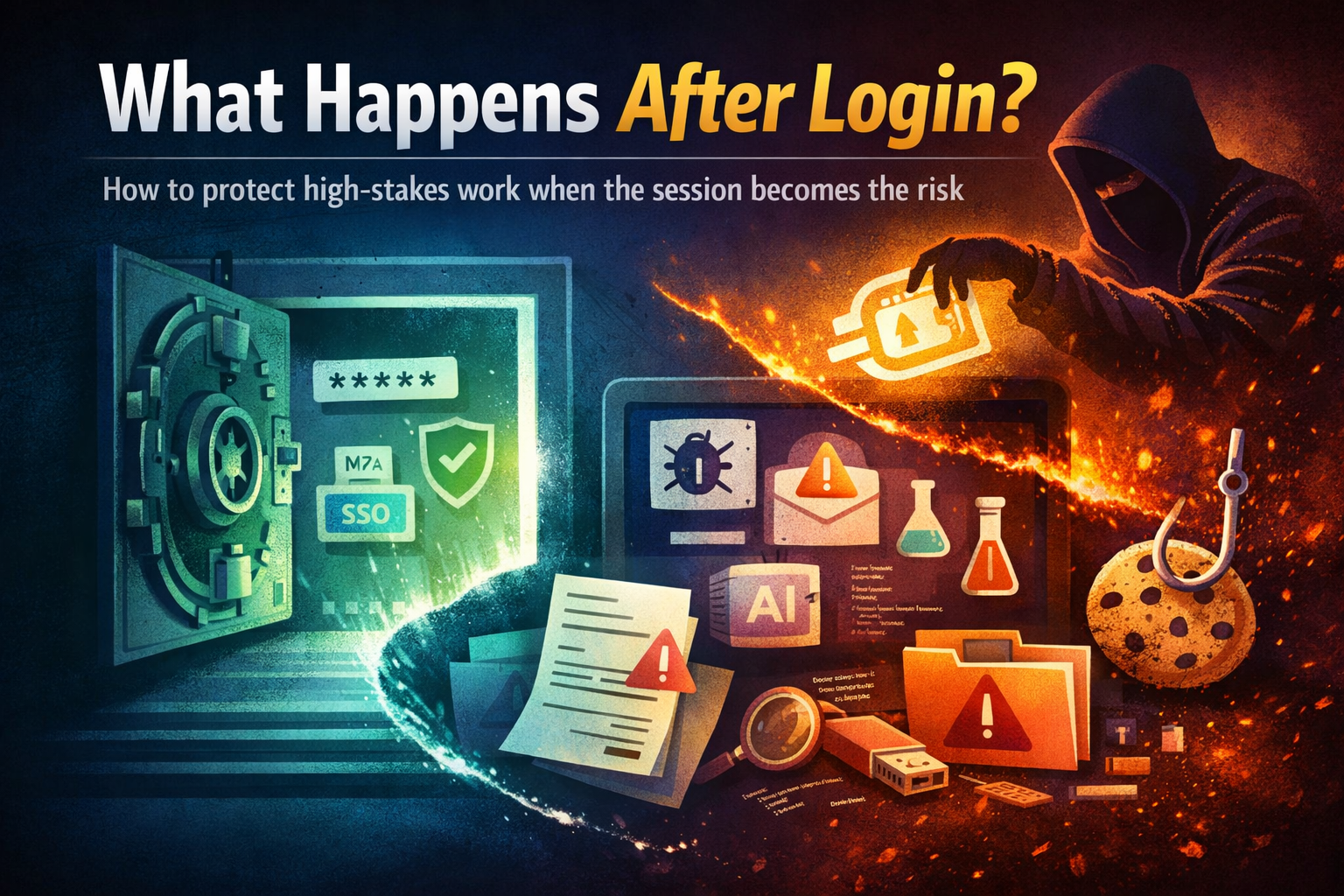
Security teams have spent years fortifying the entrance. Strong passwords, MFA, SSO, conditional access, device posture checks. Those controls have done important work. They have made opportunistic account compromise harder and raised the cost of credential theft. Yet they have also encouraged a habit of thought that no longer fits the shape of modern risk. Once the user is authenticated, the decisive moment has passed. The door is secure. The rest is administration… or is it? That confidence is harder to sustain now.
Across recent guidance from Microsoft, Google Cloud, and CISA, the same concern keeps resurfacing in different forms: token theft, session replay, browser-in-the-middle attacks, and post-authentication abuse all show how much danger can gather after access has already been granted. Microsoft’s guidance on token theft focuses on how attackers exploit live tokens and authenticated sessions. Google has highlighted session-cookie theft and device-bound session protections. CISA continues to track attacker use of alternate authentication material that can bypass the protections organizations associate with the login event itself.
For organizations responsible for sensitive research, suspicious content analysis, software validation, external collaboration, or AI evaluation, that shift has real-world consequences. We used to only worry about who got in. Now, we need to extend that level of caution to what unfolds once the session is alive.
Inside the front door
Identity became the center of enterprise security for sensible reasons. If attackers were stealing passwords and reusing credentials, stronger authentication was the clearest answer. The industry invested heavily there, and much of that investment paid off. It still matters but isn’t enough.
Microsoft’s token theft playbook makes the limitation plain. A user can authenticate successfully and still lose control of the session through stolen or replayed tokens. Google has described how infostealers and browser-in-the-middle techniques can undermine the protection people assume MFA provides, especially when session material is exposed and reused elsewhere. In other words, identity can be proven while the session itself remains vulnerable.
Risk taking up residence
Work no longer arrives in the neat format which enterprise architecture once preferred. It moves through browsers and SaaS applications, collaboration tools, AI interfaces, vendor trials, research portals, developer sandboxes, and unfamiliar web properties. Sessions last longer. Context shifts faster. Approved tools sit beside provisional ones. Users move between environments carrying data, assumptions of trust, and unfinished judgments with them. Under those conditions, the live session begins to matter just as much as the login event that created it.
That is why recent guidance has shifted toward layered protections for tokens, device binding, risk-based controls, and better detection of post-authentication abuse. The concern is not theoretical. Microsoft documents token replay as a real attack path. Google’s security teams have written about session stealing and the need to reduce the value of stolen cookies. CISA has likewise warned that attackers use alternate authentication material to gain access without needing the original password.
Valid access, then, can still produce dangerous conditions. The user may be legitimate. The task may be legitimate. The exposure appears in the interaction itself: the unknown file, the external platform, the copied text, the uploaded document, the test account created in haste, the prompt entered into a tool whose boundaries are still uncertain.
Exposure, within legitimate work
The clearest examples tend to come from work that is both necessary and difficult to sanitize in advance.
- A threat analyst must open suspicious links, inspect malicious infrastructure, and handle material that should never touch an ordinary endpoint.
- A procurement or engineering team may need to evaluate a new vendor by creating an account, uploading sample data, and testing integrations before formal approval exists.
- An intelligence team may conduct external research where exposure and attribution have consequences of their own.
- A business unit experimenting with AI tools may be acting with full authorization and good intent, yet still create uncertainty around prompt handling, file retention, and the movement of sensitive information into external services.
None of this begins with an invalid login. The trouble emerges in the ordinary unfolding of work.
High-stakes cyber work often requires interaction with suspicious content, third-party software, untrusted research surfaces, and emerging AI tools. The work cannot simply be forbidden, because the business still needs answers, decisions, and progress. It has to happen somewhere. The question is where, and under what conditions.
Beyond the narrow frame of browser protection
Browser controls remain valuable, and better session telemetry is plainly useful. Security leaders do need to understand what happened during a session, what data moved, and which actions should have triggered concern. Yet a more consequential issue sits beneath that operational visibility. Where is the risky work actually taking place, and how much trust is being placed in the endpoint while it happens?
This is where many organizations are beginning to widen the frame. They are not only looking for safer browsing. They are looking for a secure setting for consequential work, one that can contain uncertainty without bringing ordinary business motion to a halt.
The direction of broader industry guidance points the same way. Microsoft recommends layered defenses against token theft and replay, including hardening, detection, and mitigation. Google has emphasized device-bound credentials and limits on stolen-cookie usefulness. Those are meaningful controls, but they also reveal a larger truth: the more valuable the session becomes, the more carefully the environment surrounding it must be designed.
A secure place for high-stakes work
That is where isolated environments begin to matter in a fuller sense.
An isolated environment changes the place in which the work occurs. Instead of asking the endpoint, and by extension the enterprise, to absorb the uncertainty of every unknown link, vendor trial, suspicious file, external research task, or early AI experiment, the organization can move that work into a space built for ambiguity.
The value is not only containment, though containment matters. It is also continuity. Teams still need to investigate, test, compare, validate, and decide. A security model that responds only with friction eventually teaches the business to look for side doors. A model that offers a secure environment for risky work preserves momentum while reducing the blast radius of the task.
This is the territory Replica is built to serve. Its approach centers on secure isolated environments for the kinds of activity that make conventional environments uneasy: suspicious content analysis, third-party software validation, external research, AI testing, and other workflows where trust is provisional and the consequences of exposure are high. The ambition is practical. Let the work proceed in conditions that better fit its risk.
After authentication, the real test begins
The industry’s language is slowly catching up to the lived experience of security teams. Authentication remains essential, but it does not account for the full texture of exposure in modern work. Session theft, token replay, post-authentication abuse, and risky interaction with external tools all point to the same conclusion. Admission is only the beginning. Stewardship begins afterward.
For teams engaged in sensitive research, software evaluation, suspicious content handling, or early AI exploration, the decisive question is no longer exhausted by identity. It extends into the environment, containment, visibility, and control. Once the session begins, security becomes a matter of where the work lives, what the session allows, and how much of the enterprise must share in its uncertainty.
And that is where the difference is increasingly made.
FAQ
What does it mean to say the session has become the risk?
It means many important security problems arise after a user has successfully authenticated. Attackers may steal or replay tokens, and legitimate users may still perform risky work in environments that are poorly suited to the sensitivity of the task. Microsoft and Google both describe how session material can be abused after login.
Why is MFA no longer enough for high-stakes workflows?
MFA remains one of the most important controls for reducing account compromise, but it proves identity at a moment in time. It does not fully govern what happens after authentication, especially when sessions are long-lived or tokens can be replayed. Microsoft’s guidance on token theft and token protection is useful here.
Is this mainly a browser problem?
The browser is part of the story because so much work happens there, but the deeper issue is broader. Organizations are deciding where risky work should occur, how it should be contained, and what evidence and controls should follow it. Browser-in-the-middle attacks are one example of post-authentication risk, not the whole picture.
What kinds of workflows are most affected by session risk?
The pattern appears most clearly in work involving suspicious links, untrusted files, third-party software validation, external research, and AI tool evaluation. These are workflows where the user may be authorized and the business need may be real, yet the interaction itself carries unusual uncertainty.
What should security leaders evaluate in solutions for this problem?
They should look closely at where the work runs, whether risky interactions are separated from the endpoint, how session activity is observed and governed, what evidence is preserved for investigation, and whether legitimate users can move quickly through sensitive tasks without creating unnecessary exposure.
How do isolated environments help without slowing people down?
They give risky work a more appropriate setting. Instead of forcing teams to choose between unsafe speed and heavy exception processes, isolated environments let investigation, testing, and validation proceed in a contained space. That reduces exposure to the endpoint and the broader enterprise while preserving business momentum.
How is this relevant to AI use in the enterprise?
AI pilots often begin before governance is fully settled. Teams want to test tools, compare outputs, upload files, and explore real workflows. That creates uncertainty around retention, data handling, and policy. A contained environment gives organizations a way to explore those tools with greater control and less spillover risk.
