

For years, browser isolation was sold like a seatbelt: a practical way to keep malware from landing on endpoints. But the seatbelt pitch assumes the danger is the crash. In most organizations today, the bigger problem is what happens on a perfectly routine drive.
The modern workplace runs on browser-based apps. Shared docs, customer portals, internal dashboards, AI tools. Sensitive information doesn’t just live in files anymore. It moves as snippets, screenshots, exports, and copy/paste between tabs. A user opens a legitimate SaaS app, copies a table of sensitive data into another tool, downloads a report “just for a minute” to work offline, pastes customer details into a chat thread or an AI assistant. No attack happened. No malware executed. And the organization is in incident mode anyway.
That’s the shift behind a phrase you’ll hear more often this year: data-stream control. Not whether a site is malicious, but how information moves through the browser during ordinary work.
Traditional controls struggle here because they sit at the wrong altitude. They’re either too heavy, like locking everything down until people find workarounds… or too blind, trusting the endpoint and hoping users do the right thing. Neither technique scales when the browser is the operating environment for sensitive work.
There’s a gap between blocked and governed
Most browser security tools can block a download. Maybe log a URL. But can they tell you whether sensitive data was copied out, moved into an unapproved destination, or exported during a session that was supposed to be restricted? If not, you’re still guessing after the fact, and compliance is guessing with you.
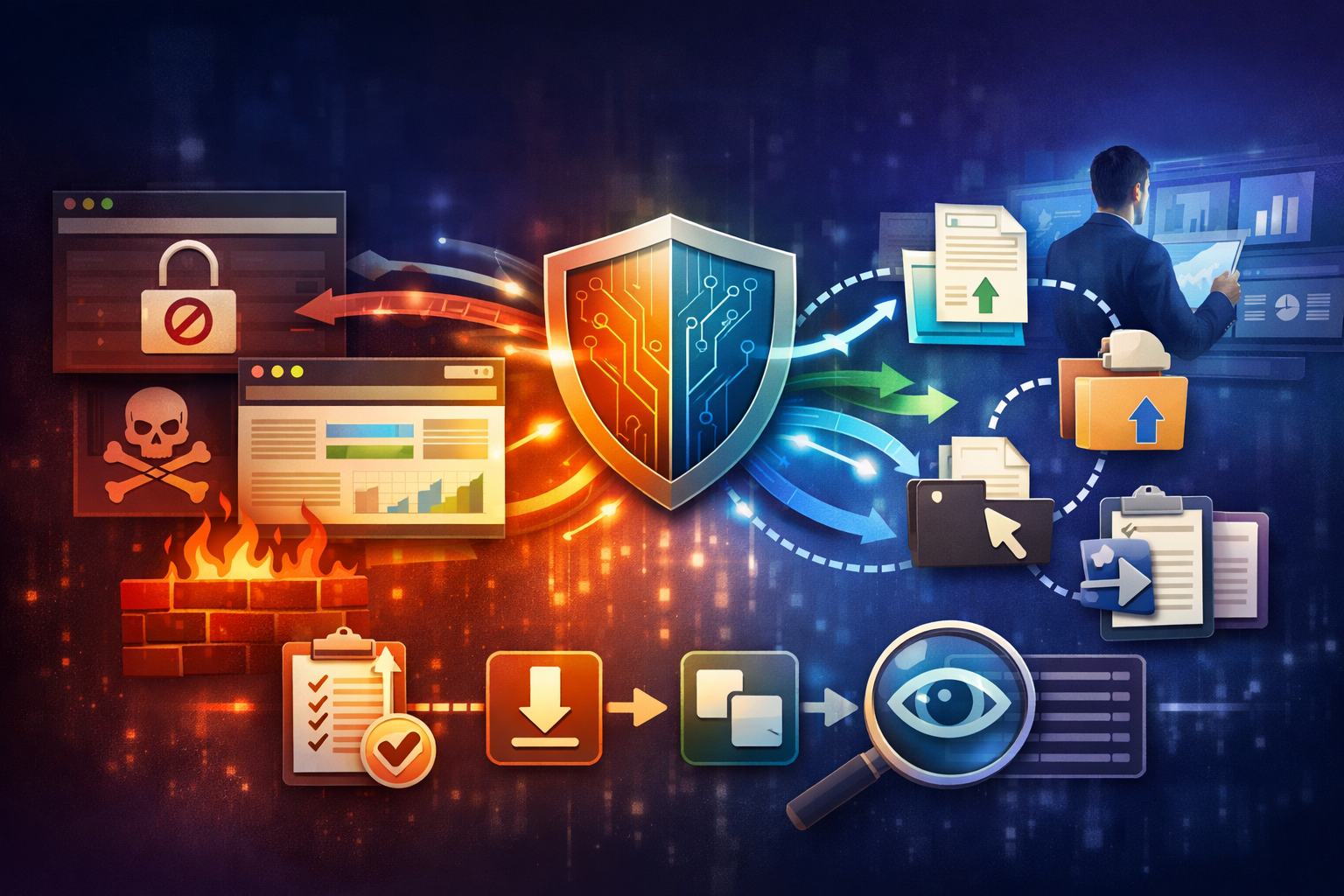
The controls that close this gap are specific: copy/paste boundaries from sensitive apps, download and upload restrictions, print and screen capture policies, session handling for credentials and tokens, and enough visibility to reconstruct what happened when something goes wrong. In a browser-first world, data movement is the attack surface. Does your security model acknowledges that or is it still optimizing for malware delivery?
Users should be able to access what they need. The organization should be able to prevent leaks, accidental and intentional. And compliance should be able to answer who did what without turning the endpoint into a surveillance device. Simple to describe. Hard to deliver.
Think of the environment as the control layer
At Replica, the most useful question isn’t “can you isolate a website?” It’s whether you can create a place where high-risk work happens safely without losing visibility into what’s moving where.
We build isolated environments that give teams freedom to work while keeping controls close to the action. Organizations can enforce when copy/paste is allowed and where it can go, decide when downloads get blocked or routed safely, define how sensitive workflows are audited, and prove chain-of-custody without relying on endpoint forensics.
When the workspace is governed, you don’t need to instrument every endpoint to figure out what happened. The environment is the record.
Evaluating solution comprehensively
If you’re looking at browser isolation or enterprise browsing tools right now, three questions cut through fast:
- Can you control data movement inside the browser without breaking how people work? Go deeper than just knowing we have DLP. See the policy running in a live session.
- Can you produce a meaningful audit trail of user actions in high-risk sessions? More than web logs. Investigation-grade visibility: what moved, where, when.
- Does the solution reduce endpoint dependence? If you still need endpoint tooling to reconstruct events, you haven’t isolated the risk. You’ve added a layer.
The conversation is shifting
Browser security is widening from a narrow malware-defense feature into a governed work layer. The browser isn’t just where websites get visited. It’s where sensitive operations happen, such as dark web research, fraud investigations, collaboration with outside parties, and new tool or AI experimentation. The vendors who understand that will build for control, proof, and productivity. The ones who don’t will keep selling seatbelts while the real risk drives right past them.
