

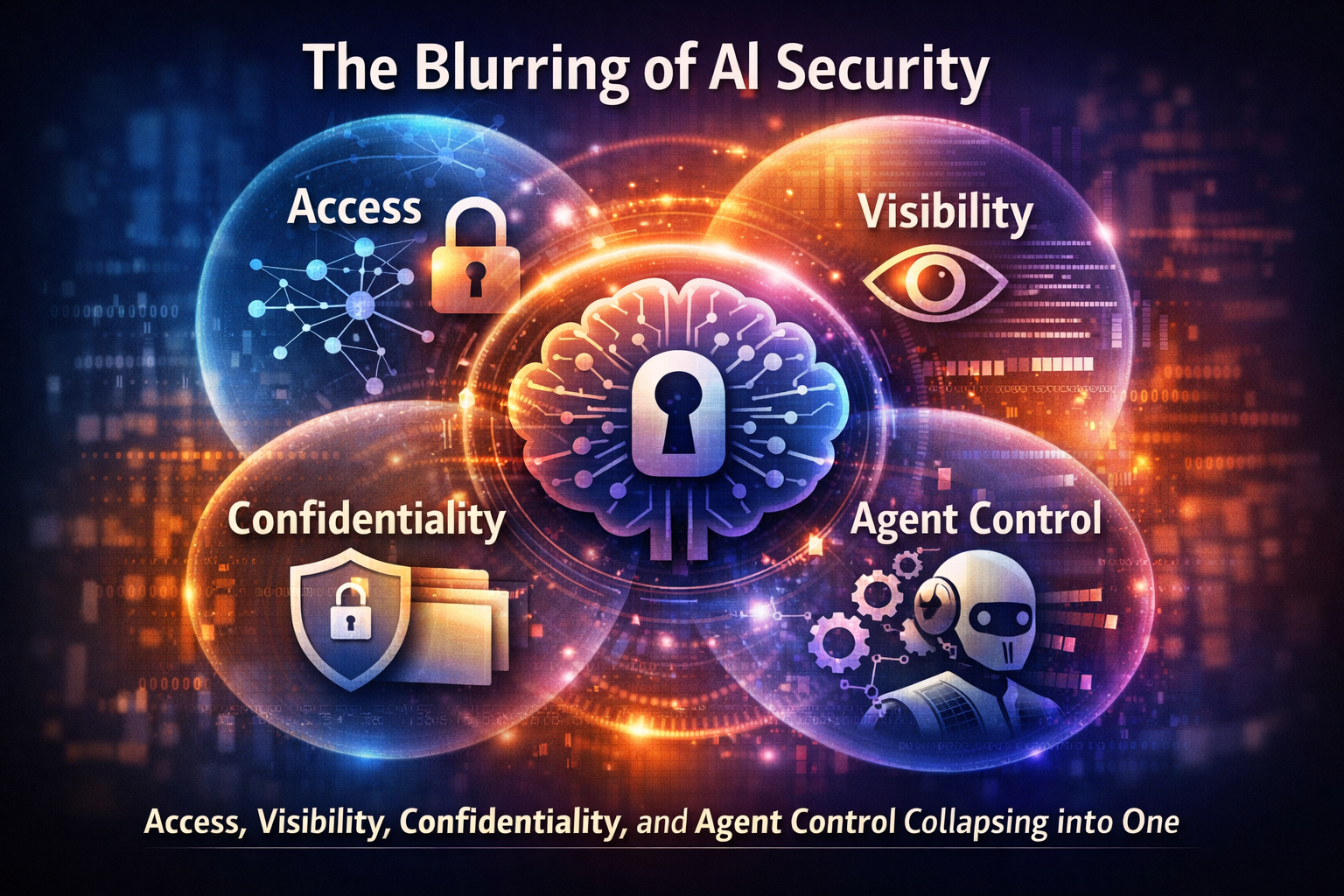
Why access, visibility, confidentiality, and agent control are being collapsed into one blurry category.
AI security means too many things at once. In one conversation, it means model safety. In another, prompt leakage. Then it’s agent permissions, policy controls, whether sensitive work can happen without revealing too much through traffic and metadata.
These problems show up in different places and require different solutions. But they’re being talked about as if they’re the same thing. The market is starting to group them together under the same umbrella. Terms like agentic AI, AI visibility, confidential AI, and agent security are showing up everywhere. The language is moving quickly.
The Vocabulary Problem
Security leaders hear “AI security” and think one category should cover it all: governance, confidentiality, visibility, agent permissions, workflow control. So, teams end up comparing policy products to visibility products. They treat observability like containment. They assume protecting prompts also protects the workflow. They ask whether an agent is allowed but never consider where that agent should be operating in the first place.
That is why this feels like a vocabulary problem before it becomes anything else.
Here are three distinctions that are especially important right now:
- Access vs. visibility. Access controls who can reach a model or agent. Visibility is what you can see while it’s being used: prompts, destinations, timing, metadata, what the agent does. You can have strong access controls and no idea what happens once usage starts. The reverse is also true. Both matter. They solve different problems.
- Confidentiality vs. context leakage. Confidentiality protects the contents of prompts, files, and outputs. Context leakage is the information exposed by the activity around the work: what’s being researched, when usage spikes, which systems are involved, how work is moving. Protected content doesn’t mean protected context. Behavior itself can be revealing.
- Governance vs. agent security. Governance is policy: who can use which tools, with what data, under what rules. Agent security is what happens once that agent is connected to systems: what it can retrieve, call, trigger, expose, or automate. Approving the use of a tool is different from understanding what it does when it starts acting inside your workflow.
Fuzziness Creates Friction
Category confusion = procurement confusion. This leads to confusion in how teams evaluate and buy. And that usually means one of two things: either teams buy something that solves only part of the problem, or they delay decisions because the category itself feels impossible to compare cleanly.
The vocabulary matters because it shapes what teams build, how they work safely, and ROI. Here’s how we think about it:
- AI access: Who or what can reach an AI model, tool, connector, or agent.
- AI visibility: What can be observed about AI use while work is happening, including actions, destinations, timing, metadata, and workflow behavior.
- AI exposure: What sensitive information is revealed through the use of AI, not just through the final output.
- Agent security: Controls on what AI agents can access, retrieve, call, trigger, or automate once connected.
- Confidential AI: Protection for sensitive AI data and computation while in use.
- Context leakage: Exposure created by traffic, metadata, timing, behavioral patterns, and surrounding workflow signals.
- Governed AI workflow: A policy-defined AI workflow with clear rules, auditability, and operational boundaries.
- Isolated AI workflow: A contained environment for evaluating or using AI tools, models, or agents without exposing corporate endpoints, production systems, or more context than necessary. Can you isolate the work? Can you see what’s happening? Who can access it? What leaves the environment? What’s the agent authorized to do?
That last category may matter more than you think. Especially for the kinds of use cases that are hardest to approve internally: evaluating new AI tools, testing agents against sensitive workflows, investigating risky sources, or enabling experimentation that would otherwise create too much exposure.
The market does not need more AI-security language for its own sake, but it needs clearer definitions. For internal teams, they make gaps easier to see, policy exceptions easier to judge, and the resulting architecture more purpose-built from the start.
